Showing posts with label hexagons. Show all posts

Sunday, January 22, 2017

Bricks Series Returns - #8 In Progress

Does this look familiar?
If you've read my posts over the last few years you've seen this top.

Click Here to see the first post on the Bricks Project

I am taking up the Bricks Project again. I've  been on hiatus from this for too long. I had to switch gears when a few other projects took priority. . . but I'm back.


I still want the answer to the question I asked in  2011:

 "How many small quilts could I make out of this one top?"

See the first 6 small quilts here
And #7 here 

I once swore that I would never make a hexagon quilt but you know what they say, "Never say never!"

For # 8 in the series,  I've decided to experience the technique of English paper piecing - the old fashioned way; trace and cut out my own papers. I know you can order them pre-cut but part of why I do these small quilts is to learn, experience and appreciate the way things were done before we had so many 'helps' on the market.


For paper I am using the little annoying inserts that fall out of magazines...a good weight I think for cutting the hexagons and making them removable.


After tracing and cutting the first few one at a time, (duh) I decided to staple 4 papers together, draw as many hexagons as possible on the top sheet and staple the center of each one enabling me to cut out four at a time.
Generous friendDawn (Collector with a Needle), gave me the metal template for tracing, (okay, I'm not a total purist), and she gave me a quick demo on basting the fabric to the paper. She has a lot of experience with hexies.

I did two the first night and my thumb joint hurt! Yes, after just TWO! I was having second thoughts about this.


Today it went more smoothly.  I tried using a small applique pin to hold the fabric to the paper and another of those pins to hold down the starting fold. That helped keep things from slipping.


I'm using up old spools of thread to baste. I don't go through the paper so once I've joined each hex on all sides I will remove those papers and re-use them.

Here's my growing pile:


My new question: 

"Will I ever 'use up' all the fabric gleaned from that c. 1910 top?"


Friday, January 13, 2012

Mosaic Patchwork - Not the Paper Piecing of Today

I recently had the good fortune to see Elegant Geometry;  American and British Mosaic Patchwork Quilts at the IQSG (International Quilt Study Center) in Lincoln, Nebraska - just before the end of its run.
No flash photography is allowed so the few photos I am posting appear 'yellowed' compared to the real quilts.


I was especially drawn to this border.  Familiar? On my last post you saw the pieced 'tall triangles' border I am doing on one of my projects. Upon close inspection I discovered that these triangles are appliqued with a whip-stitch onto a plain background!  Hmm. Would that have been easier?
I'm sorry I don't have a close-up that captures this detail but click here to see the full quilt dated 1818. It's a stunner. (Sixth quilt)


These are the tiniest hexagons I've ever seen - measuring less than 1/4" on a side.
I asked an innocent bystander to help me show the scale!


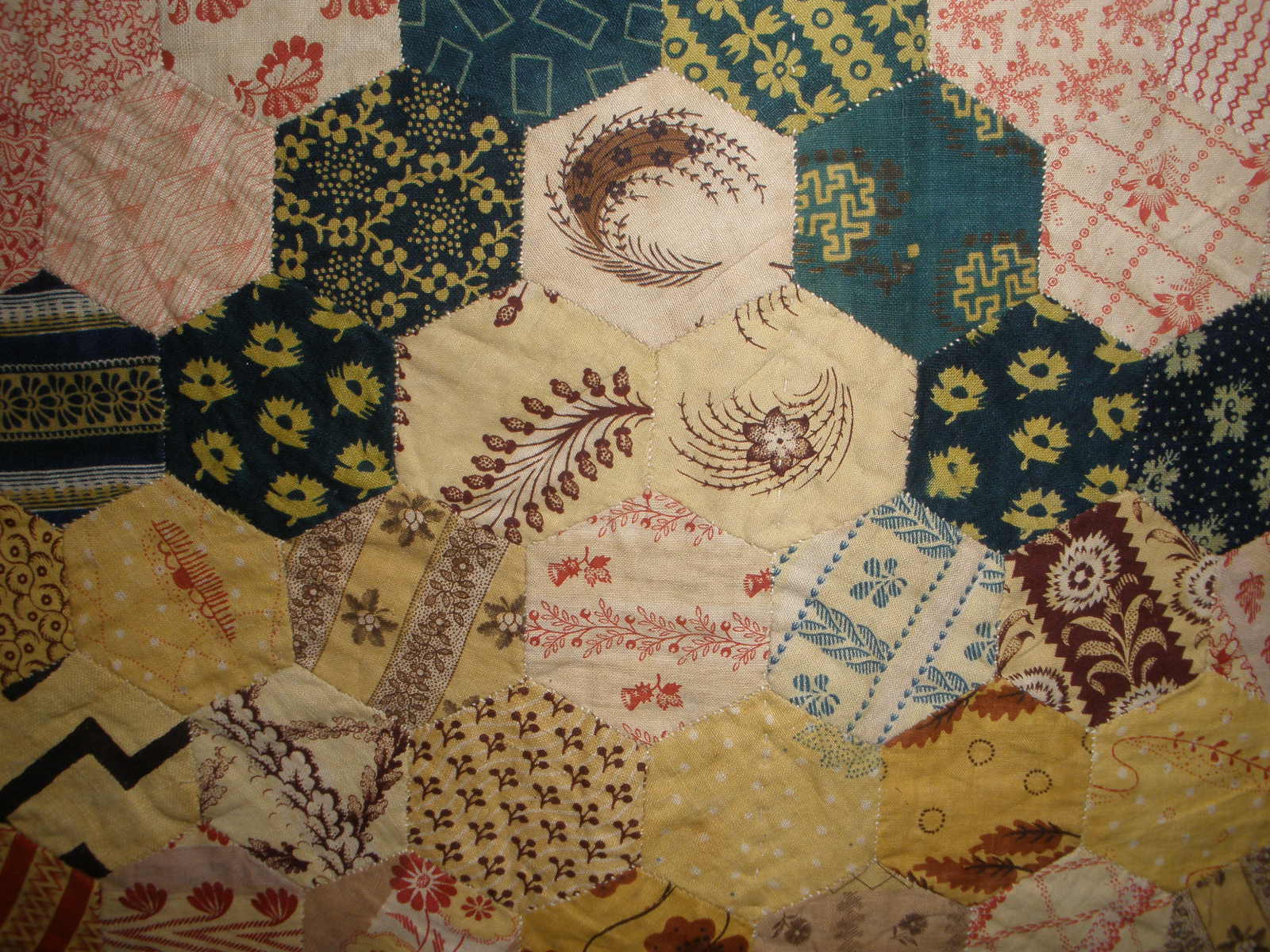
Take a look at the amazing variety of cotton prints in these close-ups...all from one quilt.
 I'd like a fat quarter of each, please!


The good news is....YOU can see all of the quilts in the exhibit! All but one are part of their permanent collection. Click here. From this page you can order the catalog, have access to the gallery notes and accompanying lecture.

If you are not familiar with the concept of English Paper Piecing it involves basting fabric to paper shapes and whip-stitching the edges together. For more specific details on the method click here.


Hexagons are not the only shape pieced using this English method but perhaps they are the shape we most often associate with it today. Triangles, squares and other shapes were also pieced this way.
The informative exhibit catalog reminds us of this  fact and I quote from the concluding paragraph, "the technique has been traced back through three centuries to eighteenth-century domestic needlework.....and has had a seminal influence on the development of the patchwork tradition" in both the United States and the UK. The catalog is well done with excellent photos including close-ups. It is available through the gift shop here.


The study center has continual exhibits. Free audio devices allow you to devote full attention to viewing each quilt while listening to information about it.

To learn more about the study center and all it has to offer, visit their website(IQSG). If you are anywhere in the vicinity it is definitely worth a stop!


By the way, next fall the AQSG seminar will be held in Lincoln !
October 4-8